
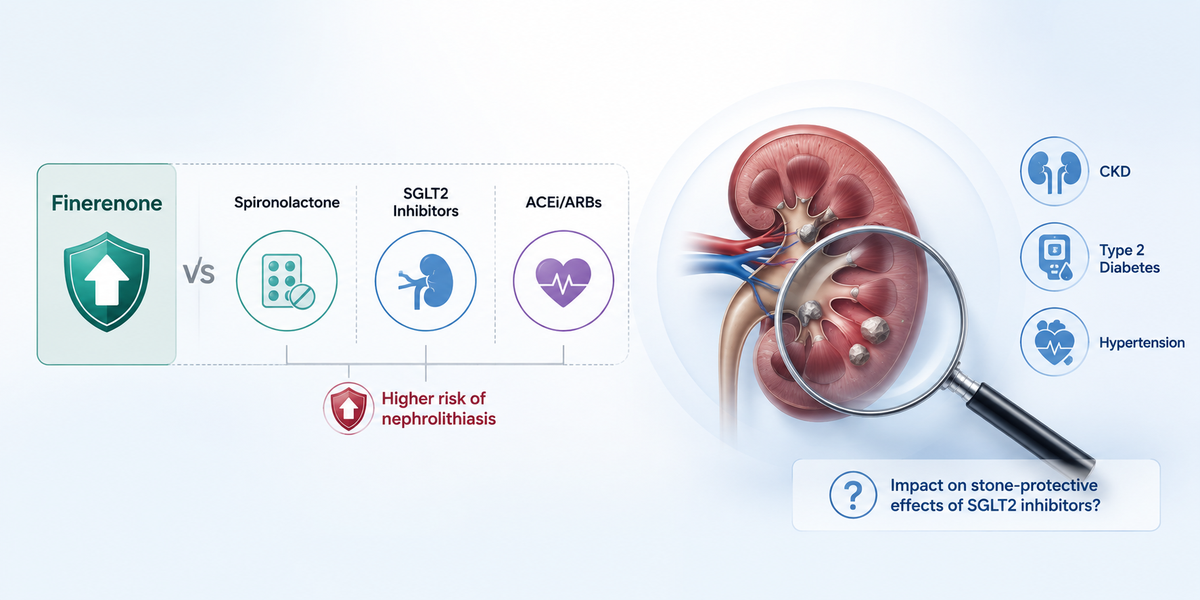
Finerenone, a non-steroidal mineralocorticoid receptor antagonist (MRA), has demonstrated renoprotective benefits in people with chronic kidney disease (CKD) and type 2 diabetes mellitus (T2DM). However, its potential association with nephrolithiasis has not been well characterized. A newly published real-world study in Scientific Reports evaluated the incidence of kidney stones among patients receiving finerenone compared with other commonly used CKD therapies.
The investigators conducted a retrospective, new-user, active-comparator cohort study using data from the TriNetX US Collaborative Network. Adults initiating finerenone between June 1, 2021, and June 1, 2024, were compared with propensity-score-matched cohorts initiating spironolactone, sodium-glucose cotransporter-2 inhibitors (SGLT2i), or angiotensin-converting enzyme inhibitors/angiotensin II receptor blockers (ACEi/ARB). The primary outcome was a new diagnosis of nephrolithiasis occurring between 4 and 16 months after treatment initiation.
Following propensity-score matching, finerenone was associated with a significantly higher risk of incident nephrolithiasis compared with each comparator. The hazard ratio was 1.328 versus spironolactone, 1.483 versus SGLT2 inhibitors, and 1.495 versus ACEi/ARB therapy. These findings corresponded to relative increases in risk of approximately 32.8%, 48.3%, and 49.5%, respectively. The increased association remained consistent across several subgroups, including individuals with CKD, T2DM, and hypertension.
The study also examined patients with T2DM who were already receiving an SGLT2 inhibitor. In this population, adding finerenone was significantly associated with a higher risk of nephrolithiasis compared with SGLT2 inhibitor monotherapy. This observation is particularly noteworthy because previous evidence has suggested potential stone-protective effects associated with SGLT2 inhibitor therapy.
Overall, this comparative real-world analysis suggests an association between finerenone treatment and a higher incidence of new-onset nephrolithiasis compared with several standard CKD pharmacological therapies. Importantly, the study demonstrates an association rather than establishing a causal relationship. The findings may warrant further investigation into the mechanisms underlying this observation and the potential interaction between finerenone and the reported stone-related effects of SGLT2 inhibitors.