
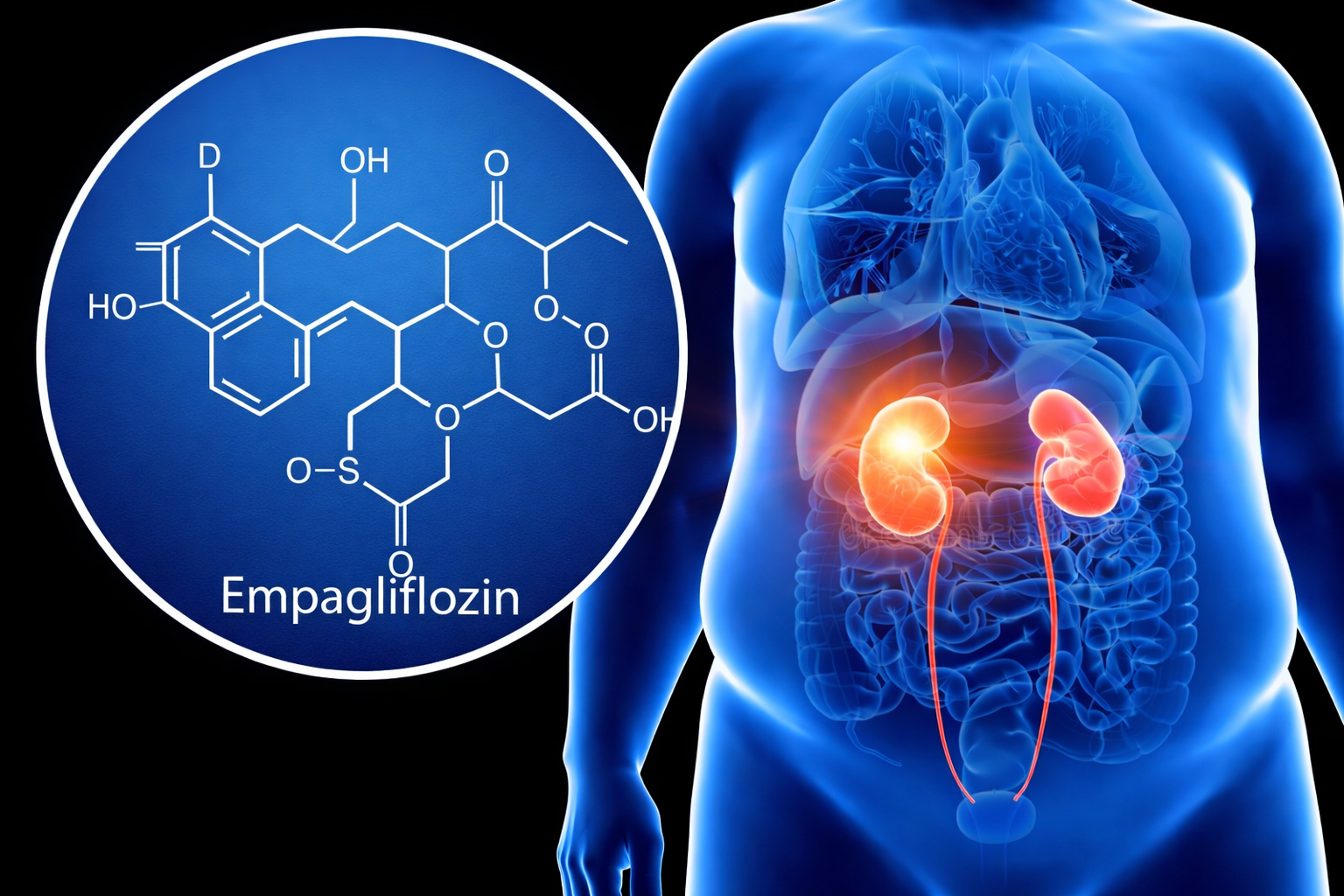
Glomerular hyperfiltration at the single-nephron level often precedes detectable whole-kidney GFR decline in type 2 diabetes (T2D). Renal functional reserve (RFR), measured as the postprandial GFR increase, may unmask this hidden hyperfiltration. Sodium-glucose co-transporter-2 inhibitors (SGLT2i) like empagliflozin reduce intraglomerular pressure via tubuloglomerular feedback, often causing an initial GFR dip. We hypothesized that lower baseline postprandial RFR predicts greater empagliflozin-induced GFR reduction, but not responses to dipeptidyl-peptidase-4 inhibitor (linagliptin) or sulfonylurea.
This pooled analysis combined data from two 8-week, randomized, double-blind, parallel-group mechanistic trials (RENALIS and RACELINES) in 71 overweight T2D patients (age 65±7 years, BMI 30.4±3.9 kg/m², HbA1c 7.8±1.0%, GFR 86.5±17.6 mL/min/1.73m²) on metformin background. Patients received empagliflozin 10 mg (n=20), linagliptin 5 mg (n=27), or sulfonylurea (glimepiride 1 mg or gliclazide 30 mg; n=24). Measured GFR (mGFR; inulin/iohexol clearance) and effective renal plasma flow (ERPF; PAH clearance) were assessed fasting and post-protein-rich meal at baseline, with intrarenal hemodynamics via Gomez equations, fractional sodium excretion, and systemic parameters. Primary interest was correlation between baseline postprandial mGFR change and 8-week treatment-induced mGFR change.
Meal stimulation increased mGFR (+7.3±1.7 mL/min/1.73m², P<0.001) and ERPF (+44.3±14.9 mL/min/1.73m², P=0.005), reduced renal vascular resistance (-0.02±0.01 mmHg/L/min, P<0.001) via afferent arteriolar relaxation, and lowered fractional sodium excretion (-0.21±0.05, P<0.001). Postprandial mGFR rise correlated with vascular resistance change (r=-0.57, P<0.001) but not baseline mGFR. At 8 weeks, empagliflozin decreased mGFR (-9.1±3.2 mL/min/1.73m², P=0.016), linagliptin showed no change, and sulfonylurea trended downward (P=0.054). Baseline meal-induced mGFR change strongly predicted empagliflozin’s 8-week mGFR change (r=0.88, P<0.001), with no correlation for linagliptin or sulfonylurea.
In T2D patients with preserved GFR, baseline postprandial RFR robustly predicts the magnitude of GFR dipping with empagliflozin, likely reflecting correction of single-nephron hyperfiltration, but does not predict GFR responses to linagliptin or sulfonylurea. Postprandial RFR may serve as a noninvasive biomarker to identify patients with greater hemodynamic benefit from SGLT2i therapy.
Link: https://academic.oup.com/ndt/advance-article/doi/10.1093/ndt/gfag025/8471545