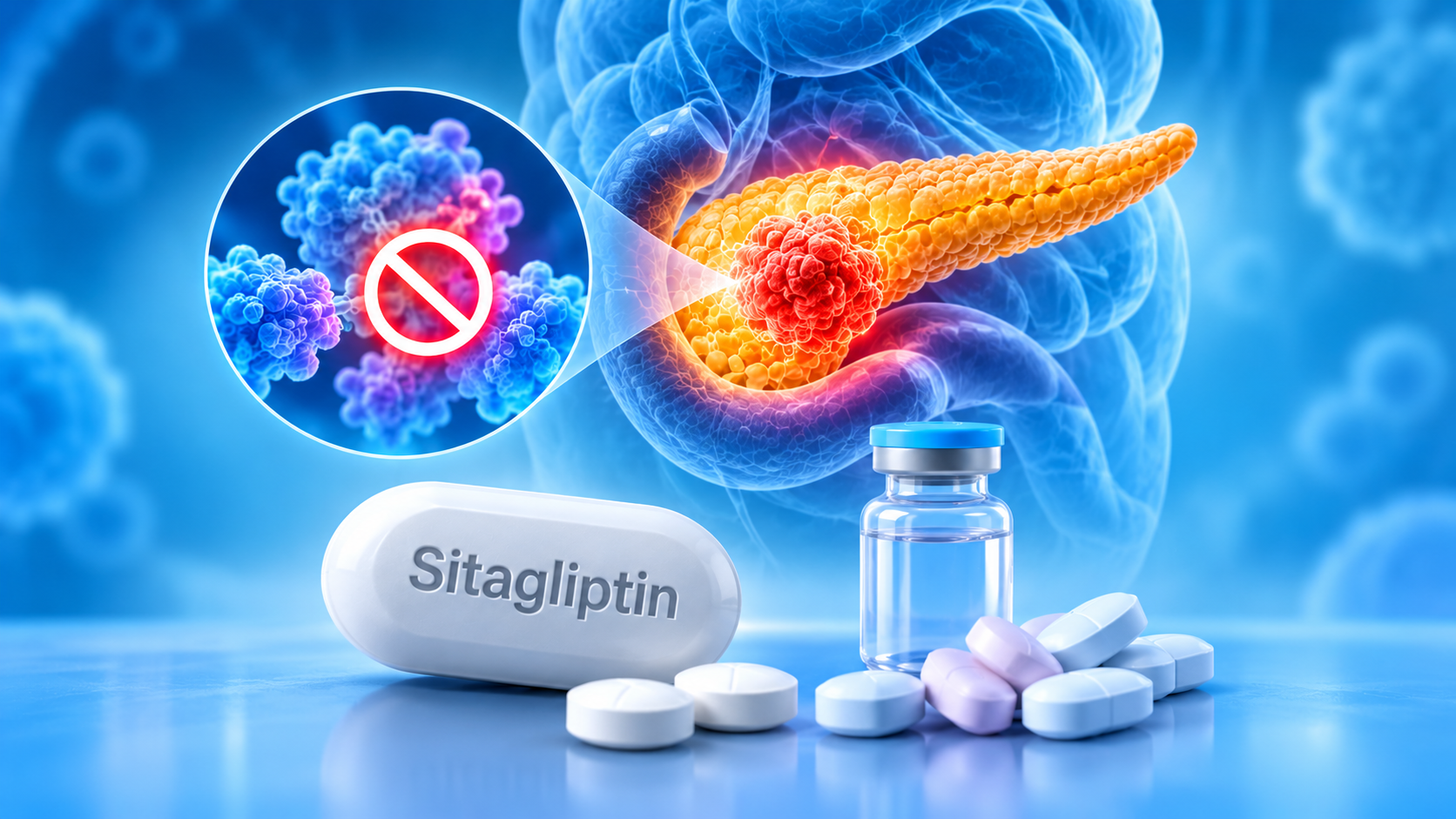

Gemcitabine-based chemotherapy remains an important treatment option for pancreatic ductal adenocarcinoma (PDAC), but the development of drug resistance significantly limits its clinical effectiveness. Elevated ribonucleotide reductase (RNR) activity, particularly involving its RRM1 and RRM2 subunits, is implicated in gemcitabine resistance by maintaining intracellular nucleotide pools and reducing the drug’s effectiveness. Researchers investigated sitagliptin, an established dipeptidyl peptidase-4 (DPP-4) inhibitor used in type 2 diabetes, as a potential chemosensitizing agent.
Using artificial intelligence-guided drug repurposing and structure-based virtual screening, investigators identified sitagliptin as a candidate inhibitor of the RRM1/2 complex. Molecular dynamics simulations and subsequent experimental studies demonstrated that sitagliptin reduced RRM1 and RRM2 protein expression, thereby enhancing gemcitabine sensitivity. Its activity was evaluated across pancreatic cancer cell lines, patient-derived organoids and animal models. Sitagliptin restored chemotherapy sensitivity in gemcitabine-resistant models and enhanced the antitumor activity of both gemcitabine plus nab-paclitaxel (GnP) and FOLFIRINOX.
The investigators subsequently conducted SITGEM-CARE, a single-center, open-label phase II trial involving 22 evaluable patients with locally advanced or metastatic PDAC. Participants received oral sitagliptin 100 mg once daily alongside gemcitabine 1,000 mg/m² and nab-paclitaxel 125 mg/m² on days 1 and 8 of each 21-day treatment cycle. The combination demonstrated an objective response rate (ORR) of 36.4% (8/22) and a disease control rate (DCR) of 86.4% (19/22). Tumor shrinkage was observed in 86.4% of patients. At a median follow-up of 9.9 months, median progression-free survival (PFS) was 6.6 months, while median overall survival (OS) reached 12.5 months. The median duration of response among responders was 12 months.
The combination demonstrated an encouraging safety profile, with no Grade 4 or 5 treatment-related adverse events, treatment-related serious adverse events, or toxicity-related treatment discontinuations reported. The findings suggest that sitagliptin may offer a novel drug-repurposing strategy for enhancing chemotherapy effectiveness in pancreatic cancer through RRM1/2 modulation. However, the small sample size, single-arm design, and single-center setting limit conclusions regarding comparative efficacy. These promising results warrant validation through adequately powered, multicenter randomized clinical trials before sitagliptin can be considered an established component of pancreatic cancer treatment.